
Find Michigan Divorce Decree Records
Michigan divorce decree records are kept at the Circuit Court in the county where the case was filed. Each of the state's 83 counties has a Circuit Court Clerk who holds the full case file, including the signed judgment of divorce. You can search for divorce decree records online through the MiCOURT case search portal, visit the courthouse in person, or request copies by mail. This guide covers how to find, access, and request Michigan divorce decree records from Circuit Courts and state agencies across all counties and major cities.
Michigan Divorce Decree Records Overview
Where Michigan Divorce Decree Records Are Kept
In Michigan, divorce decree records are held at the Circuit Court level in the county where the divorce was granted. The County Clerk serves as the Clerk of the Circuit Court and is the official keeper of all case files. This means the full judgment of divorce, the original complaint, financial statements, and any related court orders are stored at the county where the case was filed. Most county circuits hold records going back to the mid-to-late 1800s, and a few go back even further.
Michigan has a state vital records office run by the Michigan Department of Health and Human Services (MDHHS). However, MDHHS only holds divorce verifications and certificates, not the actual decree itself. A divorce certificate confirms that a divorce occurred and lists the names of the parties, the date, and the filing county. If you need the full judgment of divorce with all of its terms and orders, you must go directly to the Circuit Court Clerk in the county where the case was heard. The MDHHS office is the wrong place to request a certified copy of the decree.
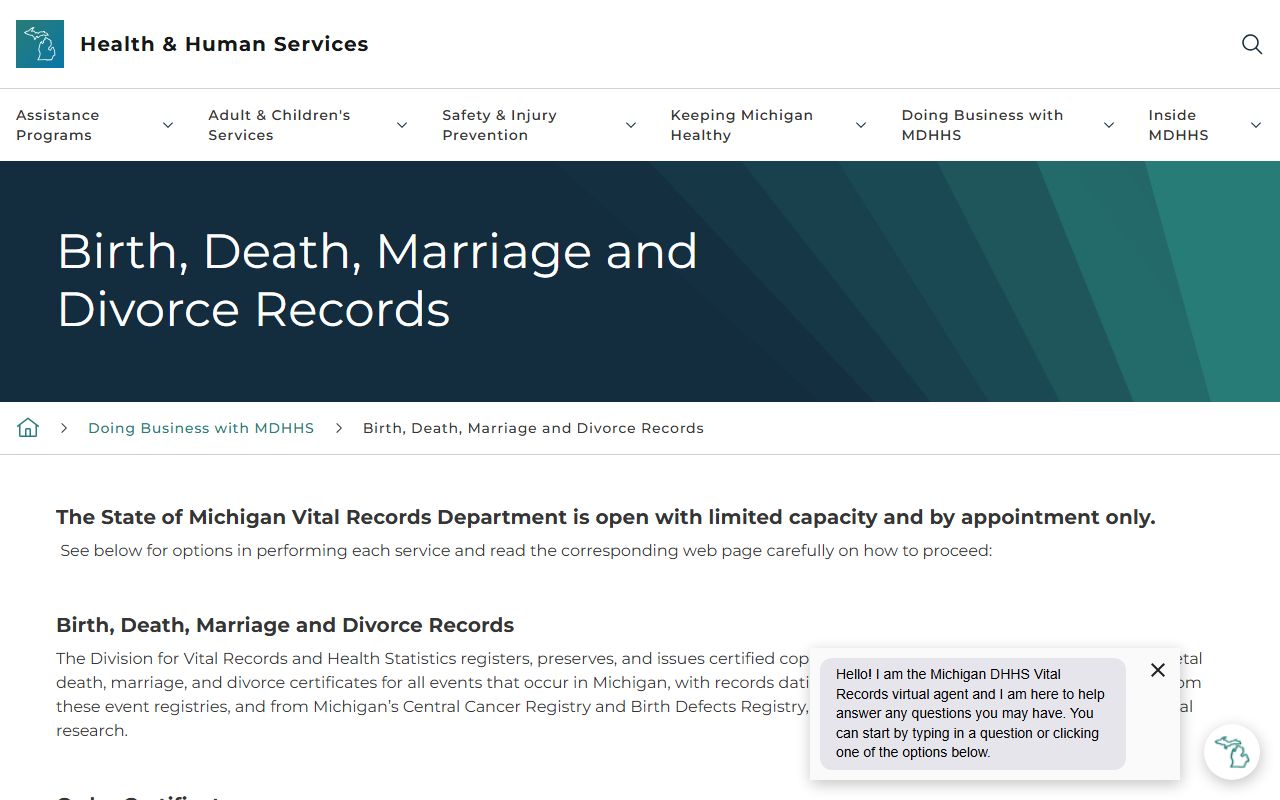
The Michigan MDHHS Vital Records page shows the types of records available through the state office. Divorce certificates are listed, but the office makes clear that full decrees must come from county Circuit Courts. The state has maintained divorce records since 1897, though records before 1924 may not have been filed with the state.
Michigan Divorce Decree vs. Divorce Certificate
Michigan issues two distinct types of divorce documents, and it's worth knowing the difference before you request anything. A divorce decree is the full court judgment signed by the judge. It contains every term of the case, including property division, spousal support, child custody, parenting time schedules, and child support amounts. You get the divorce decree only from the Circuit Court Clerk. A divorce certificate is a shorter official document that confirms the divorce took place. You can get a divorce certificate from either the Circuit Court or through the MDHHS Vital Records office.
Most people who need proof of a divorce for legal or personal reasons need one of these two things. Banks, lenders, passport agencies, and government offices often accept a divorce certificate when you need to confirm marital status. But if you need the specific terms of the judgment, you need the full divorce decree from the court. These are two separate records from two separate sources.
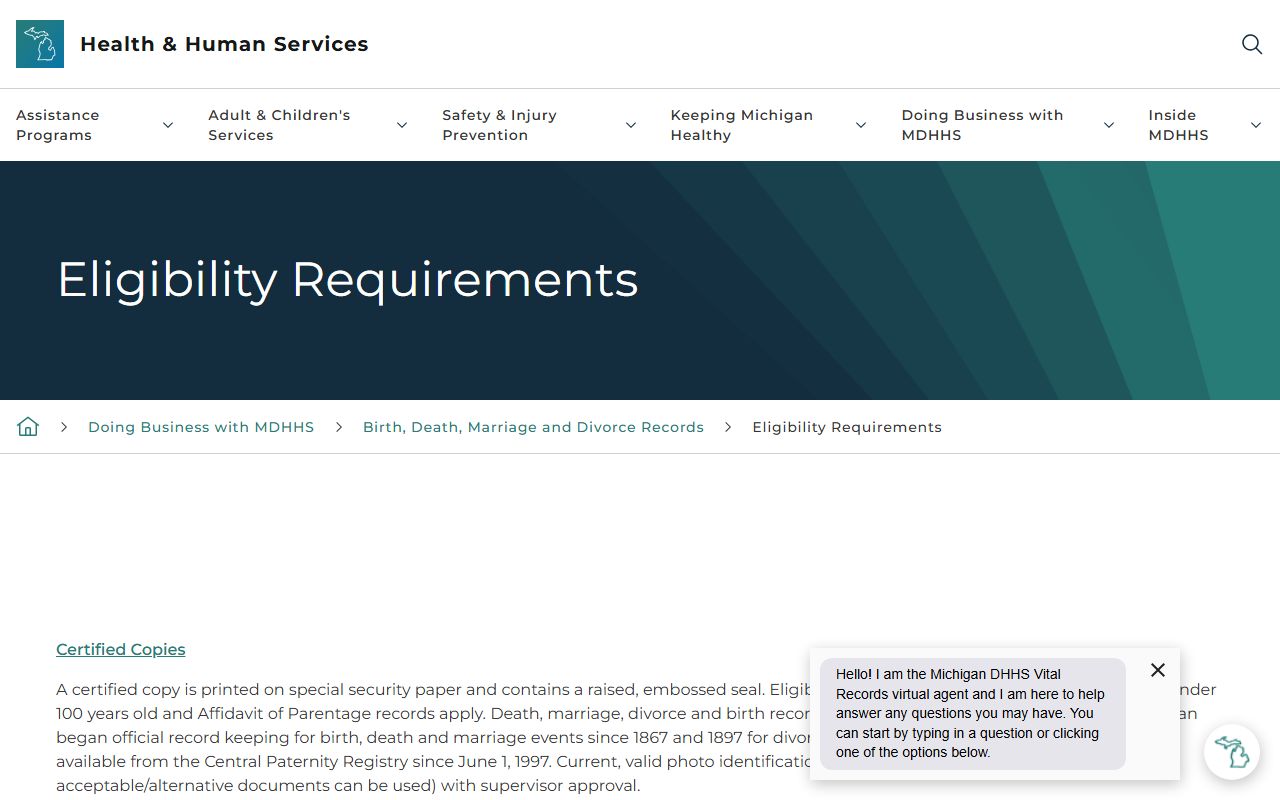
The MDHHS eligibility page outlines who can request divorce records through the state office and under what conditions. Note that the state office handles divorce verifications and certificates only, not the full decree.
How to Search Michigan Divorce Decree Records Online
Michigan Courts operates an online case search tool called MiCOURT. You can access it at courts.michigan.gov/case-search. This free tool lets you look up basic case info for most Circuit Court cases statewide. You can search by party name, case number, or date range. Results show party names, docket entries, filing dates, and case status. MiCOURT does not provide access to the actual documents. It shows docket data only, not the text of the divorce decree itself.
To run a search, you need at least one spouse's full legal name or the case number. Results can be filtered by county and case type. Divorce cases appear as family division filings. The tool is free and does not require an account. It works for most Michigan counties, though some smaller counties may have limited data in the system. For certified copies of actual divorce decrees, you still need to contact the Circuit Court Clerk in the county where the case was filed.
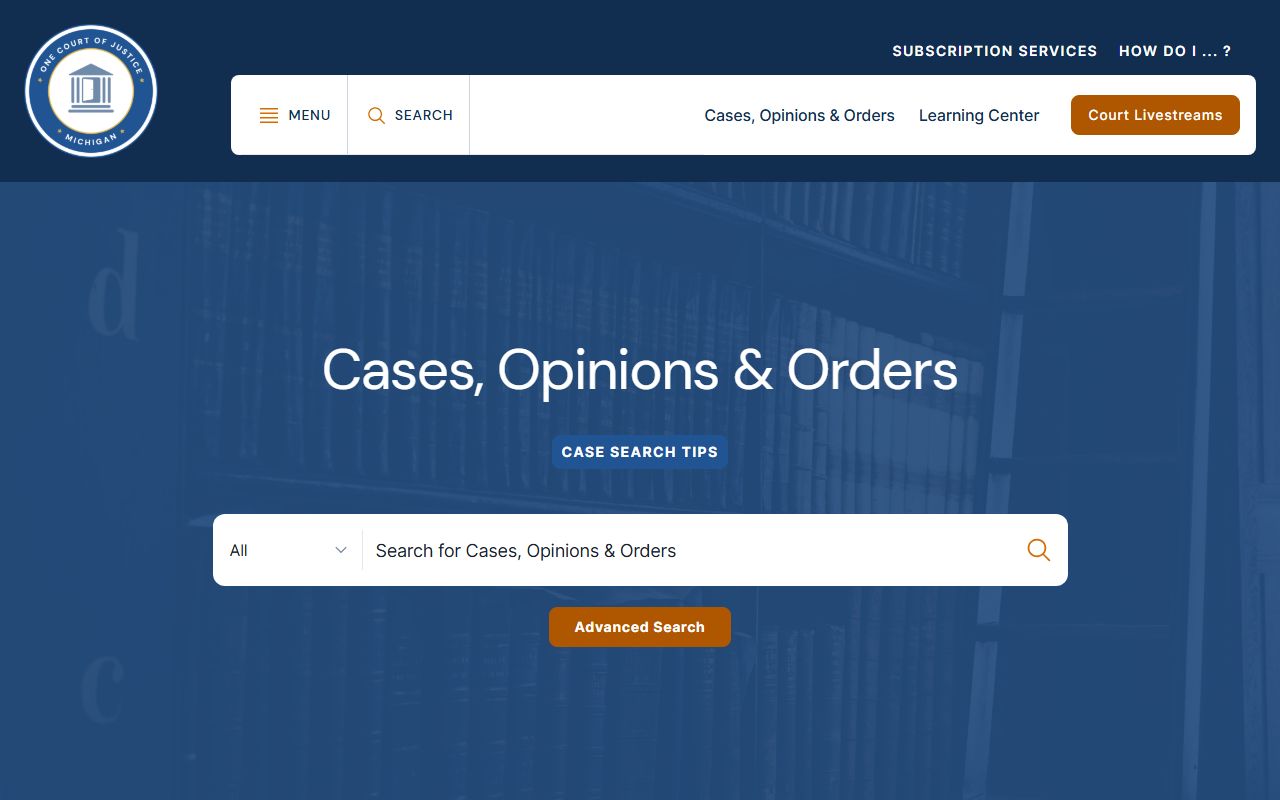
The MiCOURT portal provides basic case lookup for Michigan divorce decree records filed across the state's 83 county circuit courts. Use it to confirm a case exists and get the case number before contacting the clerk for certified copies.
Note: MiCOURT shows case data only. It does not give access to the actual judgment of divorce or other filed documents. Contact the Circuit Court Clerk directly for certified copies of divorce decree records.
Michigan Divorce Decree Laws and Statutes
Michigan is a no-fault divorce state. Under MCL 552.6, a court may grant a divorce when there has been a breakdown of the marriage relationship to the extent that the objects of matrimony have been destroyed and no reasonable likelihood remains that the marriage can be preserved. You do not need to prove fault or wrongdoing by either party. Courts apply this standard in every Michigan divorce case.
The divorce decree is not the only document generated during a case. Under MCL 552.13, courts can award spousal support as part of the final judgment. Under MCL 552.18, pension and retirement benefits earned during the marriage are part of the marital estate and may be divided in the decree. Under MCL 552.15, courts can enter temporary orders for child custody and support while a case is pending. All of these terms end up in the final divorce decree, which is the document kept in the court's records file.
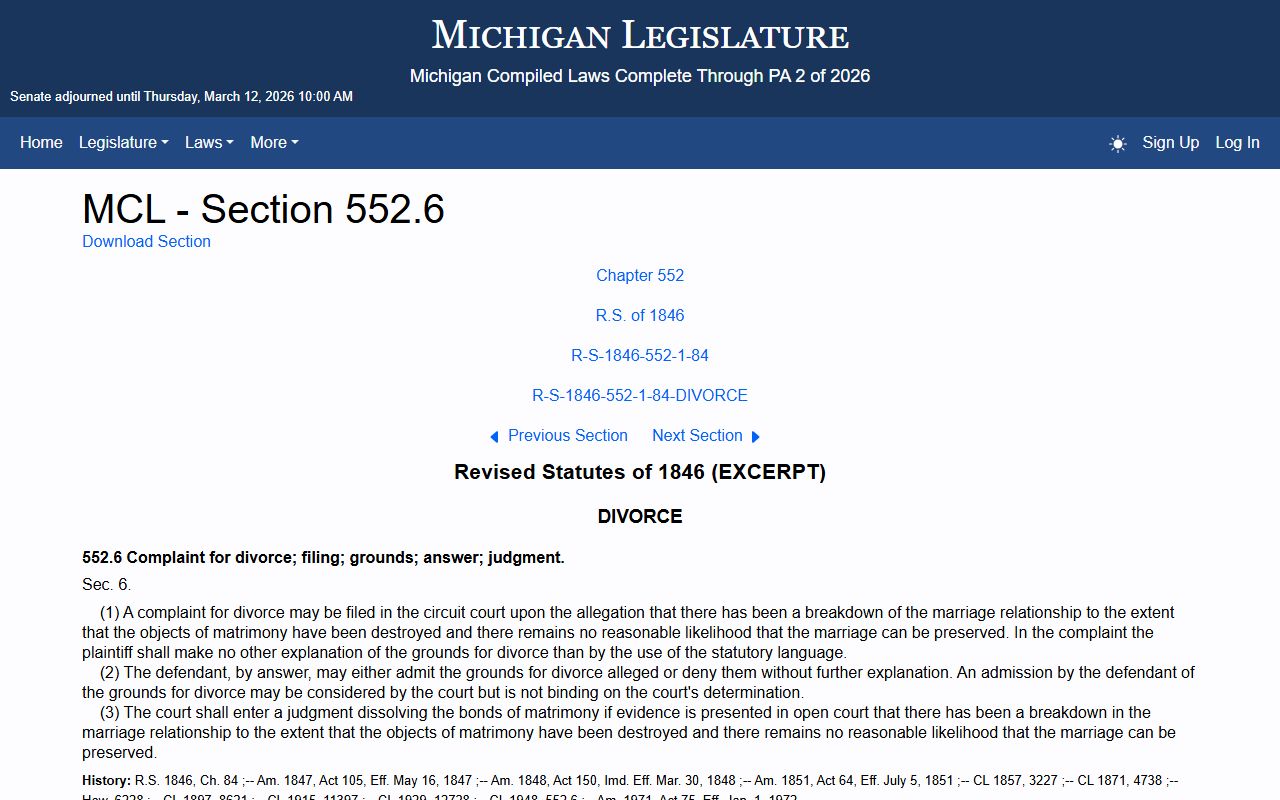
The Michigan Legislature website displays MCL 552.6 in full. This no-fault statute is the legal basis for the vast majority of Michigan divorce decree filings across all 83 counties.
MCL 552.1 covers void marriages in Michigan, and it can play a role in cases where the parties seek an annulment rather than a divorce. That said, most family law matters result in a divorce decree rather than an annulment. The decree is the final word from the court on how the marriage is dissolved and what each party's rights and duties are going forward.
Residency Rules and Waiting Periods for Michigan Divorce
Before you can file for divorce in Michigan, you must meet the state's residency rules. Under MCL 552.9, at least one party must have lived in Michigan for 180 days before filing. The filing party or the other spouse must also have lived in the county where the complaint is filed for at least 10 days immediately before filing. These rules apply to both contested and uncontested cases.
Michigan also has mandatory waiting periods before a court can enter a judgment of divorce. If there are no minor children in the case, the court must wait at least 60 days after the complaint is filed. If minor children are involved, the waiting period is at least 180 days. A judge can shorten the 180-day wait in cases of extreme hardship, but courts do not waive this period often. These time limits directly affect when a divorce decree is entered and recorded at the court.
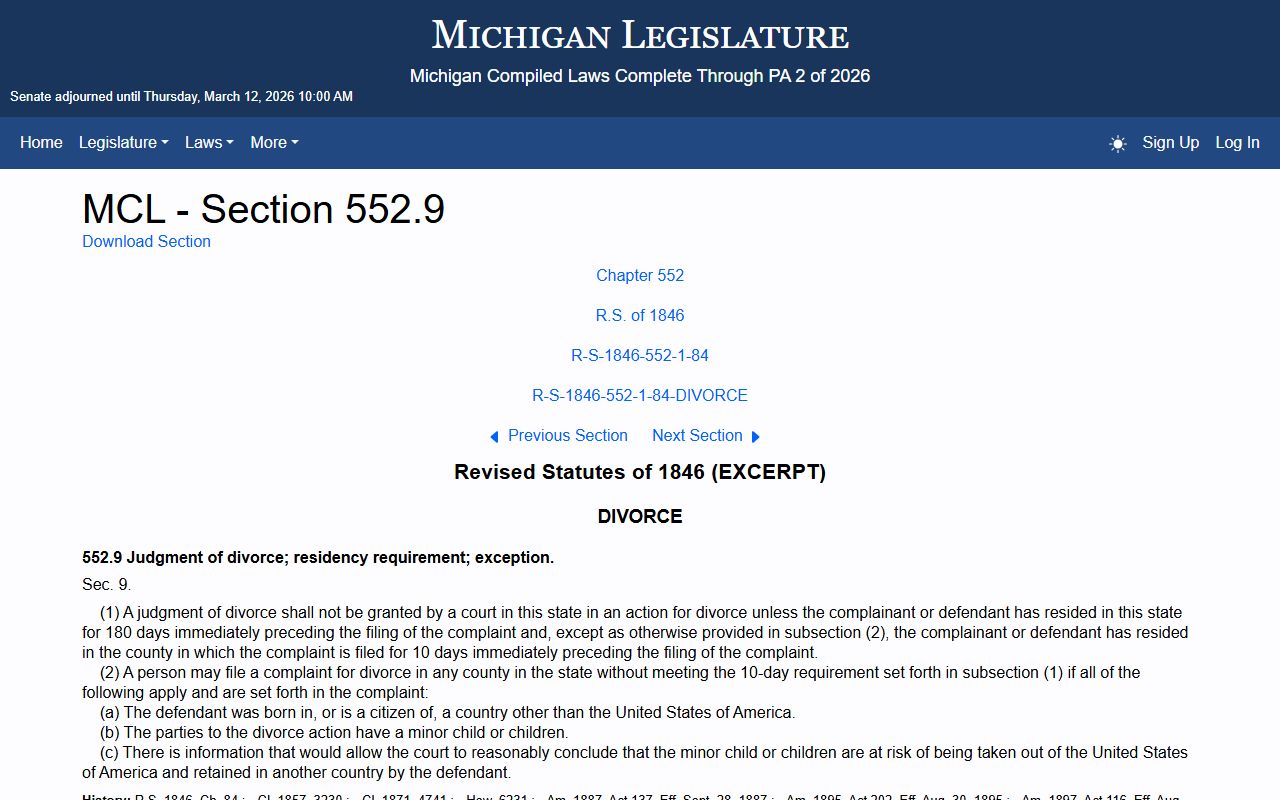
MCL 552.9 at the Michigan Legislature website sets out the full residency and waiting period requirements that apply to all Michigan divorce decree proceedings, including both contested and uncontested cases.
How to Get a Certified Copy of a Michigan Divorce Decree
To get a certified copy of a Michigan divorce decree, contact the Circuit Court Clerk in the county where the divorce was filed. You can request records in person, by mail, or in some cases online depending on the county. You need the names of both parties and an approximate date or case number to locate the file. Some courts charge a search fee plus a per-page copy fee. Certified copies carry the court's official seal and are accepted as proof of the divorce by government agencies, lenders, and other institutions.
Fees vary by county. Many Michigan counties charge $10 to $15 for the first certified copy and $1 to $5 for each additional copy. Eaton County charges $11.50 for the certification plus $1.00 per page. Lapeer County charges $15.00 per certified copy. Lenawee County charges $16.00 for the first certified judgment and $6.00 for each additional. Call the specific county court before you send a request to confirm current fees and required information.
If you only need a divorce certificate rather than the full decree, you can order through MDHHS. The order by mail page at michigan.gov explains the process. Standard processing takes 21 to 45 business days. A rapid service option takes 1 to 5 business days. Online ordering is available through VitalChek, the only authorized online provider for Michigan vital records. The first copy of a divorce certificate through MDHHS costs $34.00 plus VitalChek fees and shipping.
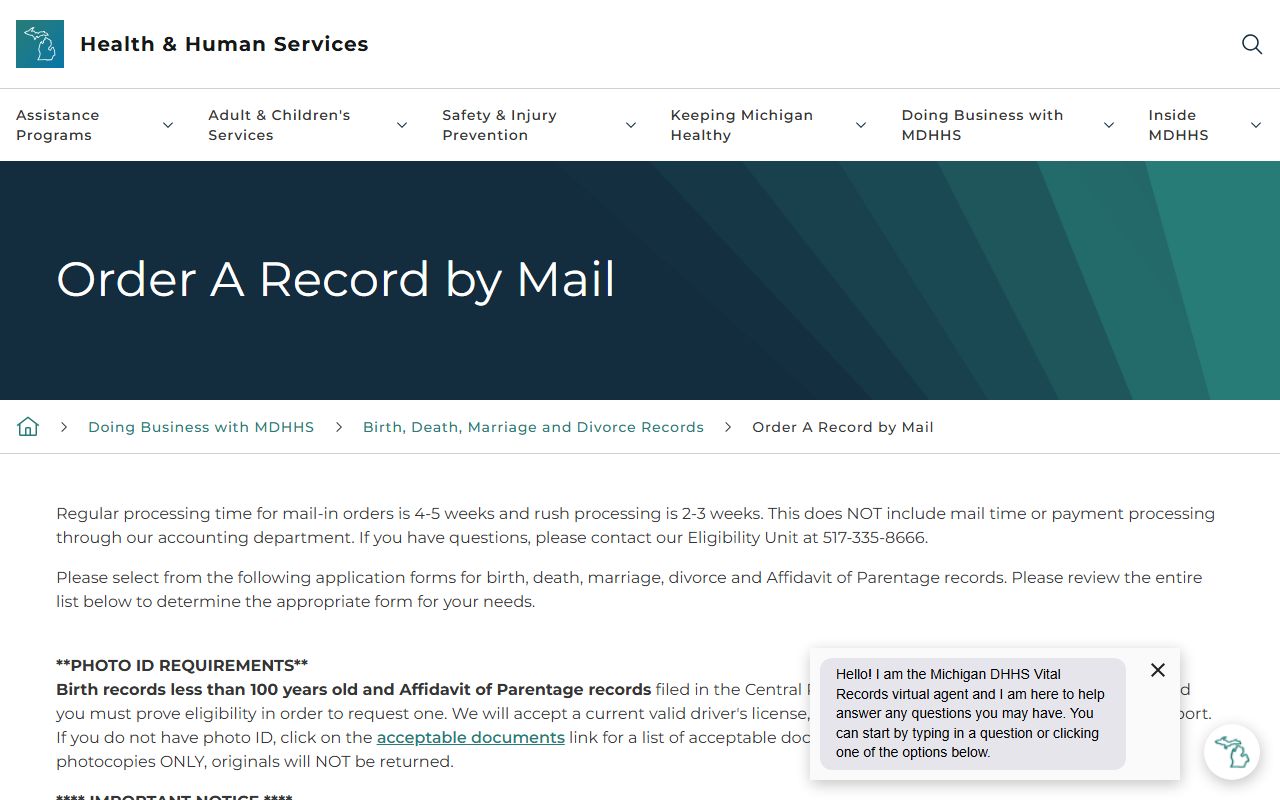
The MDHHS order by mail page walks through the steps for requesting divorce certificates through the state office, including fee schedules, processing times, and required documentation.
VitalChek is the only authorized online provider for MDHHS vital records orders. You can use VitalChek to order divorce certificates, but full decree copies must still come from the county Circuit Court.
Legal Help Resources for Michigan Divorce
Michigan Legal Help at michiganlegalhelp.org is the state's main self-help legal resource. It offers plain-language guides to the divorce process, interactive forms, and tools to help people handle their own cases without an attorney. The site covers every step of a Michigan divorce from filing the first papers to receiving the final decree. It also has a lawyer referral tool to help you find local legal aid organizations if you qualify.
MiCourt Forms provides all official Michigan court forms at no charge. These include every form needed to file for divorce, respond to a divorce complaint, and handle related family law matters like custody and support. Legal aid groups in most parts of Michigan offer free services to people with low income who cannot hire an attorney on their own.
Michigan Legal Help is a free statewide resource that guides residents through the process of obtaining a divorce decree and helps people find and fill out the right court forms.
Note: Michigan Legal Help and MiCourt Forms provide self-help tools, not legal advice. For complex cases involving significant property, custody disputes, or domestic situations, consult a licensed Michigan family law attorney.
Are Michigan Divorce Decree Records Public?
Yes. Most divorce records in Michigan are public. The case file at the Circuit Court is open to anyone who asks for it. You do not need to be a party to the case. You do not need to explain why you want the records. Some financial statements filed with the court may have limited access under state privacy rules. Details about minor children can be restricted or redacted from public copies in some cases. A party can ask the court to seal specific records, but courts only do this in limited circumstances.
Divorce records at the state level through MDHHS are also public. Michigan Compiled Laws govern access to vital records statewide. Divorce verifications from MDHHS are available to any requestor. Certified divorce decrees from the Circuit Court are similarly public. Most requests go through without the requester needing to show a specific reason or connection to the case. This open access has been a feature of Michigan's public records system for many decades.
Browse Michigan Divorce Decree Records by County
Each of Michigan's 83 counties has a Circuit Court that holds divorce decree records for cases filed there. Choose a county below to find local contact details, fees, and resources for divorce decree records in that area.
Divorce Decree Records in Major Michigan Cities
Michigan residents file for divorce at their county's Circuit Court. The city where you live determines which county court handles your case. Pick a city below to learn where to get divorce decree records in that area.